Family Tray or Live Pasta Station: Two Different Ways to Feed a Group
Compare same-day pasta trays with a live chef pasta station for group dining.
Family Tray or Live Pasta Station: Two Different Ways to Feed a Group
A family tray is food for the table. A live Pasta Station is part of the event. Both feed a group, but they ask different things of you and they produce a different afternoon or evening. Choosing between them begins with the experience you want, not only the number of guests.
Most people start this decision by counting heads. That is the wrong first question. A group of forty can be perfectly happy with trays set out on a long table, and a group of thirty can feel flat if nothing is happening in the room. Start with what you want the food to do, then work backward to the format.
Start with the room, not the headcount
Ask yourself one thing: is the food supposed to disappear quietly into the background, or is it supposed to be something guests gather around?
If the answer is background, you want trays. People are there to talk, work, celebrate a birthday, or watch a game. Food is fuel and it should not need managing. If the answer is foreground, you want the live station. The cooking becomes a place people walk toward, a reason to move out of their seats, and part of what they remember.
When a family tray is the right call
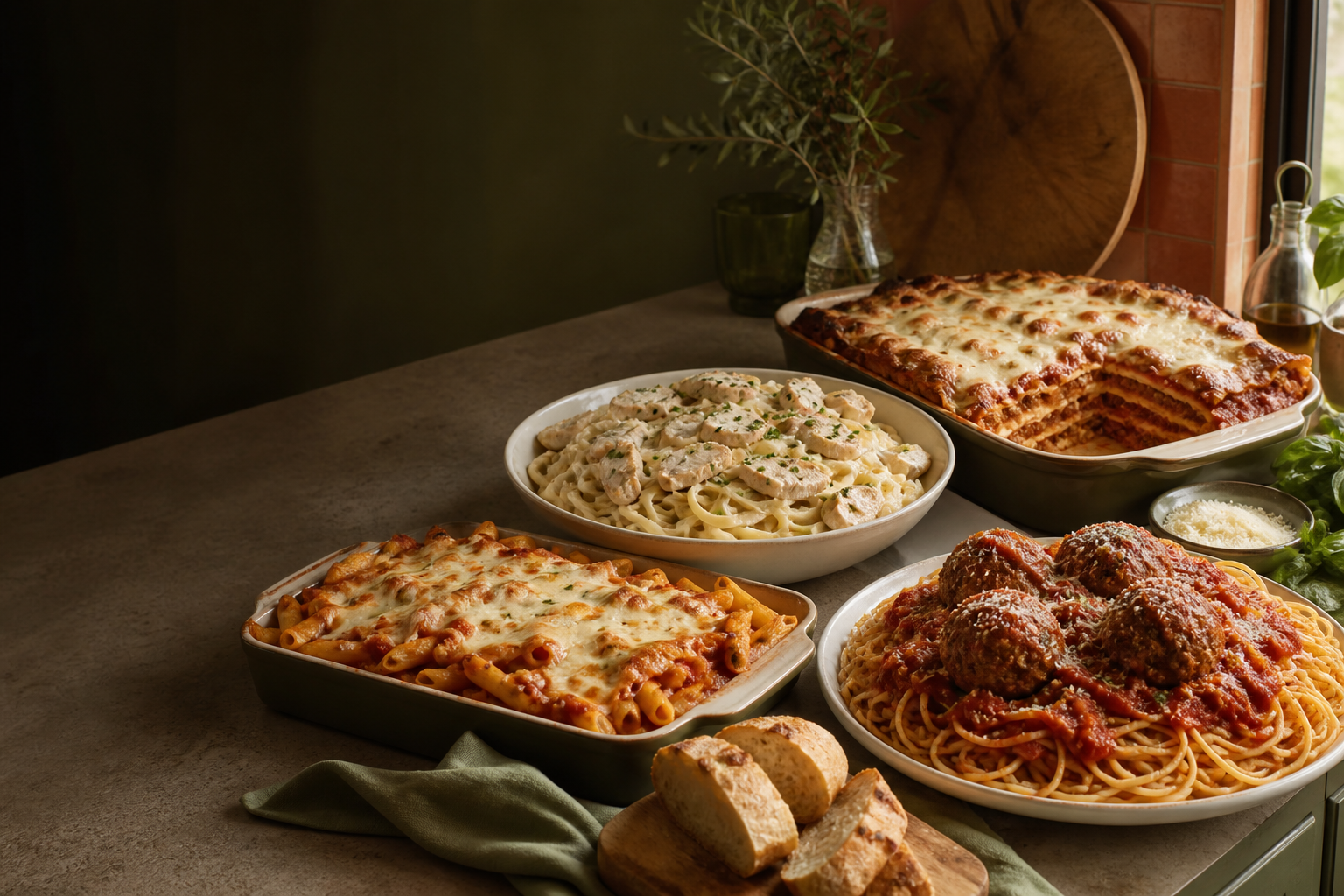
Lasagna and baked ziti trays work when the host can receive, hold and serve the food. That is the whole test. They are a practical fit for home dinners, office meals and informal gatherings.
Trays make sense when:
- You are hosting at home or in an office and already have a table, counter or credenza to work from.
- Guests arrive over a window of time rather than all at once, and you want food available whenever they show up.
- Nobody needs to be impressed. The gathering is casual by design.
- You want the simplest possible logistics on the day.
What a tray quietly assumes about you
A tray is easy, but it is not effortless. Someone has to be there to take the delivery. Someone has to keep the food at a sensible temperature until people eat. Someone has to put out plates, serve or set up self-service, and clear afterward. In practice that someone is usually the host.
If you are the host and you also want to be a guest at your own party, be honest about whether you will actually enjoy doing that job. For a Tuesday team lunch, it is nothing. For a milestone celebration where you want to be in the photos and in the conversations, it adds up.
When a live Pasta Station earns its place
The live station exists for the moments where service is part of the point. A chef is on site cooking and serving your guests, and that changes the shape of the event. There is a station to walk to, a line that turns into conversation, and food that arrives to the guest rather than the guest hunting it down.
Consider the live station when:
- The event has a program. A toast, a ceremony, a speech, a first dance. Food service needs to fit around it cleanly.
- You are the host and you need to be present with your guests, not managing a buffet.
- The venue is not your kitchen. Rented halls, offices, backyards and outdoor spaces are easier when the service comes with the food.
- You want the catering to feel like part of the event rather than an order that showed up.
The published package, in plain terms
The published event package starts at $19 per guest with a 25-guest minimum and includes menu choices, buffet setup and two hours of live-chef service.
Read that carefully, because each piece tells you something about fit:
- Starts at $19 per guest. That is the published starting point, not a final quote. Your menu choices are part of what determines where you land, so ask for the number in writing before you plan around it.
- 25-guest minimum. The package is built for groups of 25 and up. If your list is smaller than that, trays are the more sensible route.
- Menu choices. Selections are made in advance, not improvised on the day.
- Buffet setup. The station is set as a buffet, so plan a spot in the room where a line can form without cutting through the party.
- Two hours of live-chef service. This is the window you are building the event around. Two hours is generous for most gatherings, but it is a window, and your timeline should respect it.
Conditions to confirm before you book a station
The live station has requirements that a tray does not. Venue approval, covered workspace, power, timing and final selections must be confirmed in writing. Work through these early, because two of them depend on people who are not you.
- Venue approval. If you are renting a space, ask the venue directly whether on-site cooking is permitted before you commit to the format. Some venues have rules about outside catering and live cooking. Get their answer in writing too.
- Covered workspace. The station needs a covered area to work in. Outdoors, that usually means a tent, a patio roof or an overhang. Sort this out during planning, not on the morning of the event when the forecast changes.
- Power. There has to be a working power source within reach of where the station will sit. Walk the space and look for the actual outlet rather than assuming one exists.
- Timing. Service runs on a schedule. Decide when you want guests eating, then build backward from there so setup and the two-hour window line up with your program.
- Final selections. Menu decisions are locked in writing ahead of time. Give yourself room to make those choices without rushing.
A quick way to decide
If most of these sound like you, order trays: fewer than 25 guests, a home or office setting, casual timing, and someone available to receive and serve the food.
If most of these sound like you, look at the live station: 25 guests or more, a venue that allows on-site cooking, a covered spot with power, a real event timeline, and a host who wants to be a guest.
When the two lists split evenly, the tiebreaker is usually simple. Ask whether you want to be serving the food or enjoying the event.
Frequently asked questions
How many guests do I need for the live Pasta Station?
Twenty-five. That is the published minimum for the event package. For smaller groups, trays are the better fit.
How long does the chef stay?
The package includes two hours of live-chef service. Set your program around that window so guests are eating when you want them to eat.
Is $19 per guest the final price?
It is the published starting point. Your menu choices factor into the final number, and selections are confirmed in writing, so request a written quote before you budget.
Can the station go anywhere?
No. It needs venue approval, a covered workspace and power. Confirm all three before booking, especially if you are renting a space or hosting outdoors.
What is the best option for an office lunch?
Trays. Office meals are exactly the case trays are built for: a host who can receive the food, an existing table or counter, and no need for staffed service.
When do I have to finalize the menu?
Before the event, in writing. Build a few days of decision time into your planning rather than leaving selections to the last week.
The bottom line
Trays feed people well and ask you to do the serving. The live station puts a chef in the room for two hours and asks you to sort out venue approval, a covered workspace, power and a timeline in advance. Neither is the upgrade of the other. They are two different jobs.
Decide what role you want to play at your own event, then pick the format that lets you play it.